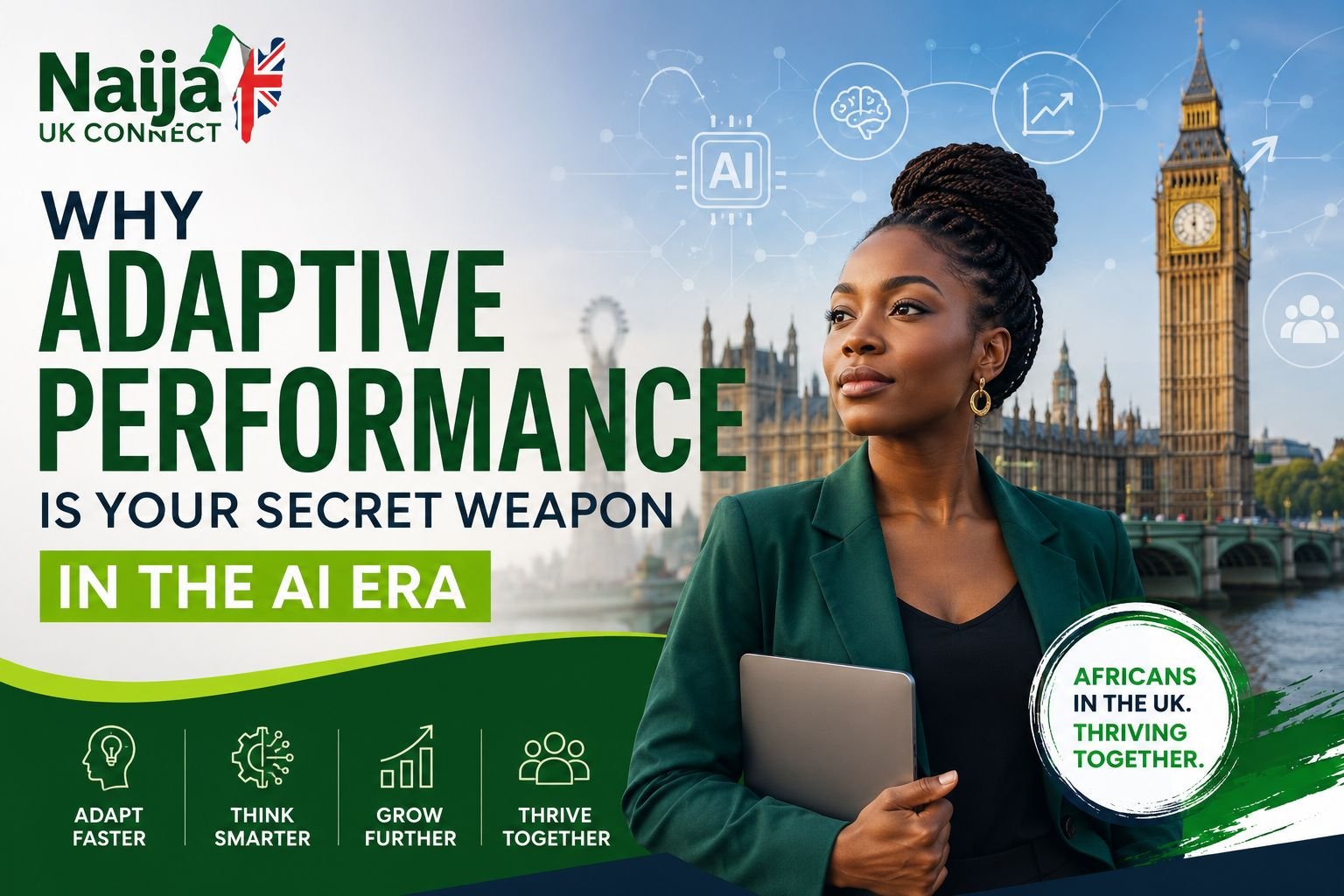
Beyond qualifications: Why adaptability now matters most
Many Africans living and working in the UK already understand what it means to adapt. From adjusting to British workplace culture and communication styles, to navigating immigration systems, credential recognition, and career transitions, adaptability is often the invisible skill behind survival and success.
Now, Artificial Intelligence (AI) is accelerating another major shift across UK workplaces. Employers are no longer focused only on qualifications or technical ability. Increasingly, they want people who can learn quickly, adjust to change, solve unfamiliar problems, and stay effective under uncertainty.
This ability is known as adaptive performance — and it is becoming one of the strongest career advantages in the AI-driven economy.
The workplace is changing fast in the UK
For decades, career success was built on:
- Doing your job efficiently
- Working well in teams
- Staying consistent in a defined role
These still matter — but they are no longer enough on their own.
Across the UK, workplaces are being reshaped by:
- Artificial Intelligence and automation
- Cost-of-living pressures and economic uncertainty
- Remote and hybrid working models
- Rapid digital transformation
- Increased global competition for roles
As a result, UK employers are prioritising workers who can:
- Learn new systems and tools quickly
- Stay calm during organisational change
- Solve problems that don’t have clear instructions
- Adapt when job roles evolve
- Think independently and creatively
These are all signs of strong adaptive performance.
Why this matters for Africans in the UK
Many Africans in the UK work in sectors where AI and automation are already making an impact, including:
- Healthcare and social care
- Administration and customer service
- Finance and banking
- IT and digital services
- Logistics and transport
- Hospitality and retail
In these sectors, AI tools are being introduced to improve efficiency and reduce costs. This means job roles are evolving quickly.
Those who resist change may find it harder to progress, while those who embrace learning and flexibility are more likely to:
- Advance in their careers
- Transition into higher-skilled roles
- Access leadership opportunities
- Move across industries successfully
- Remain competitive in the UK job market
For many migrants and international professionals, adaptability also supports:
- Navigating visa-linked job pressure and sponsorship requirements
- Building professional confidence in a new system
- Re-establishing career identity after relocation
- Expanding networks in unfamiliar environments
The AI mindset gap: Pilots vs Passengers
A useful way to understand workplace readiness in the AI era is through two mindsets:
1. Pilots
These individuals see AI as a tool, not a threat. They tend to:
- Experiment with new technologies
- Learn continuously
- Ask questions and explore possibilities
- Use AI to improve productivity
- Adapt quickly to workplace changes
Pilots stay ahead because they actively engage with change rather than avoiding it.
2. Passengers
These individuals often feel overwhelmed or uncertain about AI. They tend to:
- Avoid learning new tools
- Rely only on familiar methods
- Fear job displacement
- Use AI minimally or reluctantly
- Struggle when systems change
In many workplaces, there are still more “Passengers” than “Pilots” — which creates a growing skills gap.
Why adaptive performance is under pressure
Despite its importance, adaptability is becoming harder to sustain for many workers due to:
Constant workplace change
Frequent restructuring, digital updates, and shifting job expectations can lead to change fatigue.
Burnout and financial pressure
Rising living costs in the UK, combined with work stress, reduce the mental energy needed to adapt effectively.
Skills-focused training gaps
Many organisations focus on teaching tools, but not on building confidence, resilience, and flexible thinking.
Fear of making mistakes
In some workplaces, mistakes are still punished rather than treated as part of learning and innovation.
Why adaptability is a career superpower
Adaptive performance is like a “gear shift” for modern work life. It helps you adjust smoothly when conditions change.
In real terms, adaptable employees are more likely to:
- Stay composed during workplace transitions
- Learn AI tools faster than others
- Spot opportunities during disruption
- Recover quickly from setbacks
- Remain valuable as roles evolve
For Africans in the UK, this is especially important when balancing career growth with immigration pathways, family responsibilities, and the challenge of building new professional networks.
How to build your adaptive advantage
The good news is that adaptability is not fixed — it can be developed.
Stay intentionally curious
Don’t wait for change to force learning. Explore AI tools relevant to your job or industry now.
Develop a growth mindset
Replace “I can’t do this” with “How can I learn this?”
Build digital confidence
Take advantage of free or low-cost UK-based online learning platforms to improve digital and AI literacy.
Get comfortable with uncertainty
Career paths in the UK are no longer linear. Flexibility is now a strength, not a weakness.
Strengthen your professional network
Connect with mentors, communities, and professionals who encourage growth and shared learning.
Protect your wellbeing
Burnout reduces adaptability. Rest, balance, and mental wellbeing are essential for long-term career performance.
Final thoughts
AI is transforming the world of work, but success will not be determined by technology alone. Human strengths such as creativity, resilience, emotional intelligence, and adaptability remain critical.
For Africans in the UK, adaptive performance is more than a workplace skill — it is a long-term strategy for stability, growth, and opportunity.
Those who stay curious, embrace learning, and remain flexible in uncertain times will be best positioned not just to survive the future of work — but to thrive in it.
Join Our WhatsApp Channel
Stay updated on the latest UK news, including education, health, job openings, and more for those living in the UK!
Join here: Naija UK Channel
Also, follow us on our social media channels for the latest updates and discussions:
- Twitter: @NaijaUKConnect
- Facebook: Naija UK Connect
- Instagram: @naijaukconnect