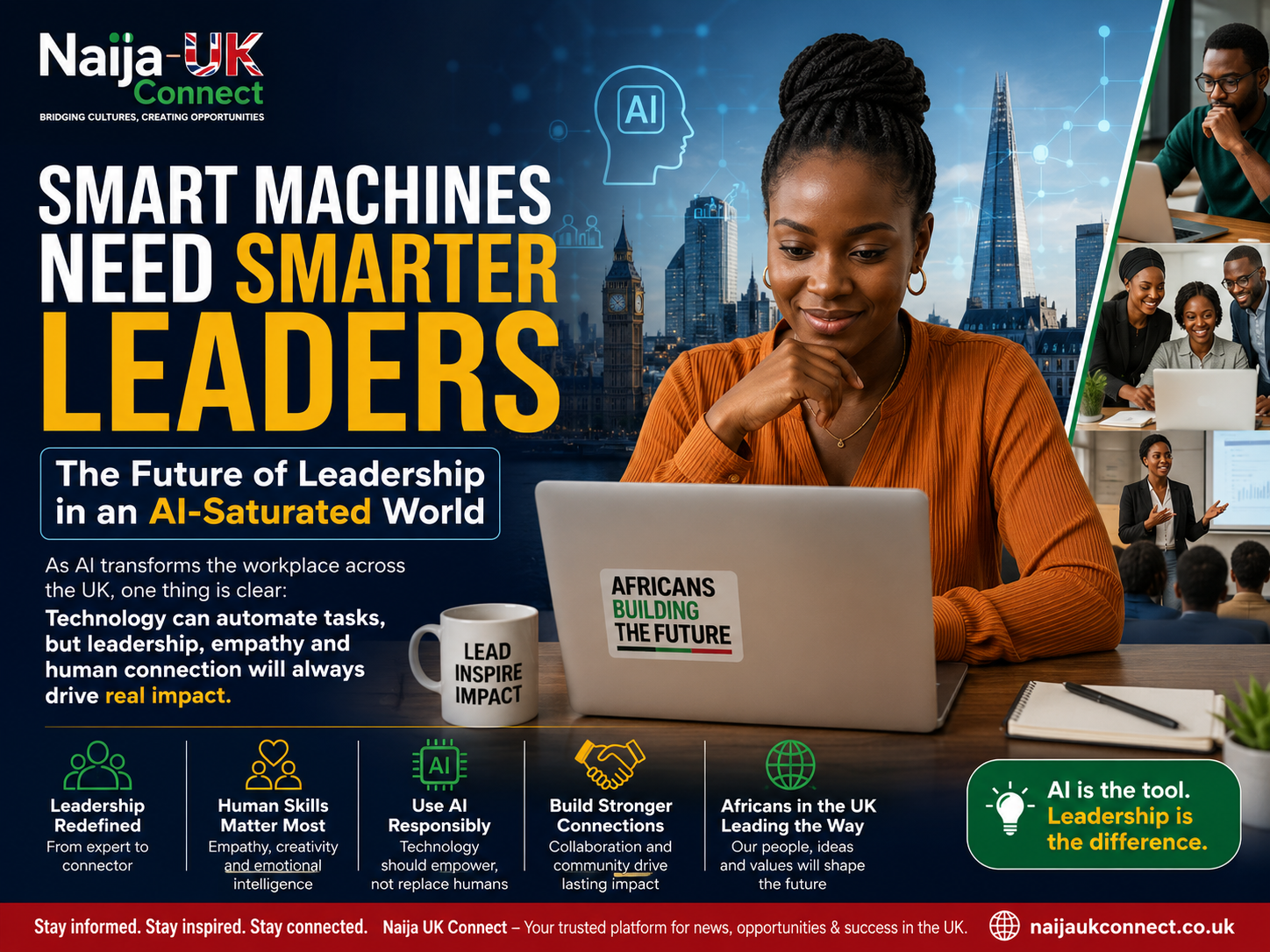
Artificial Intelligence is no longer a future concept. Across industries in the UK—from healthcare and finance to technology, education, and public services—AI is rapidly changing how organisations operate, make decisions, and deliver services.
For Africans and Nigerians living and working in the UK, this shift presents both opportunities and challenges. While AI can improve productivity and automate repetitive tasks, experts believe the skills that will truly differentiate future leaders are deeply human ones: emotional intelligence, creativity, empathy, communication, and the ability to inspire others.
At the 2025 World Economic Forum in Davos, leadership and technology experts explored what effective leadership will look like in a world increasingly shaped by artificial intelligence. Their conclusion was clear: as machines become smarter, leaders must become more human.
Leadership Is Changing
Traditionally, leaders were often valued for their technical expertise and specialised knowledge. However, as AI becomes capable of analysing information, generating reports, and solving complex problems, leadership is evolving.
Future leaders will increasingly act as connectors—bringing people together, encouraging collaboration, and helping teams navigate change.
For African professionals building careers in the UK, this means that success may depend less on simply having technical knowledge and more on the ability to manage people, build relationships, and create environments where innovation can thrive.
Employers are increasingly seeking professionals who can combine technical understanding with strong interpersonal and leadership capabilities.
Why Human Skills Matter More Than Ever
While AI can process large volumes of information in seconds, it cannot replicate genuine human connection.
Machines can assist with data analysis, customer service, scheduling, and administrative work. However, they struggle with empathy, emotional understanding, cultural awareness, and complex human interactions.
These are qualities that remain essential in sectors where many Africans in the UK work, including healthcare, education, social care, business management, and community leadership.
In a multicultural society like the UK, professionals who can communicate effectively across cultures and build trust with diverse communities will remain highly valuable.
AI and the Future Workplace
Experts predict that organisations will increasingly redesign jobs around AI capabilities.
Instead of asking how AI can support existing roles, businesses may begin by identifying tasks that AI can perform and then determining where human expertise adds the greatest value.
This shift could eliminate many repetitive administrative tasks, allowing workers to focus on higher-value activities such as problem-solving, relationship building, innovation, and strategic thinking.
For African entrepreneurs and business owners in the UK, AI also presents opportunities to automate operations, improve customer experiences, and scale businesses more efficiently.
However, technology alone will not guarantee success. Businesses that combine AI tools with strong leadership and customer-focused strategies are likely to outperform competitors.
Building Ethical and Inclusive AI
One of the key themes emerging from global discussions around artificial intelligence is the importance of responsible development.
Technology leaders argue that AI systems should be designed with people in mind and should reflect diverse perspectives and communities.
This is particularly relevant for Africans in the UK, who have often advocated for greater representation and inclusion within technology and business sectors.
Ensuring that diverse voices contribute to the development and implementation of AI can help create fairer systems that better serve all communities.
What AI Still Cannot Replace
Despite its rapid advancement, AI continues to have limitations.
It cannot replicate:
- Genuine empathy
- Human intuition
- Deep personal relationships
- Community leadership
- Crisis management under uncertainty
- Cultural understanding
- Mentorship and inspiration
These uniquely human abilities will continue to be critical in workplaces, businesses, and communities.
As one technology leader noted during discussions at Davos, computers are powerful tools—but they cannot replace the value of human guidance, teaching, and leadership.
What This Means for Africans in the UK
For Africans and Nigerians building careers in Britain, the rise of AI should not be viewed solely as a threat to jobs.
Instead, it should be seen as a call to invest in skills that technology cannot easily replicate.
Professionals who focus on leadership development, communication, emotional intelligence, adaptability, and lifelong learning will be better positioned to thrive in an AI-driven economy.
Similarly, entrepreneurs who learn how to combine AI-powered tools with human creativity and customer understanding may unlock new opportunities for growth.
The Bottom Line
Artificial Intelligence is reshaping the future of work, but the most successful professionals and leaders will not be those who compete with machines. They will be those who master the uniquely human skills that machines cannot replicate.
For Africans in the UK, the future belongs to individuals who can combine technological awareness with empathy, leadership, innovation, and community impact.
As AI becomes more powerful, the value of human-centred leadership will only continue to grow.
For more career insights, technology trends, and opportunities for Africans in Britain, stay connected with Naija UK Connect.
Join Naija UK Connect
Stay updated with the latest UK visa sponsorship jobs, relocation opportunities, and career guides tailored for Nigerians through Naija UK Connect.
Join here: Naija UK Channel
Also, follow us on our social media channels for the latest updates and discussions:
- Twitter: @NaijaUKConnect
- Facebook: Naija UK Connect
- Instagram: @naijaukconnect