
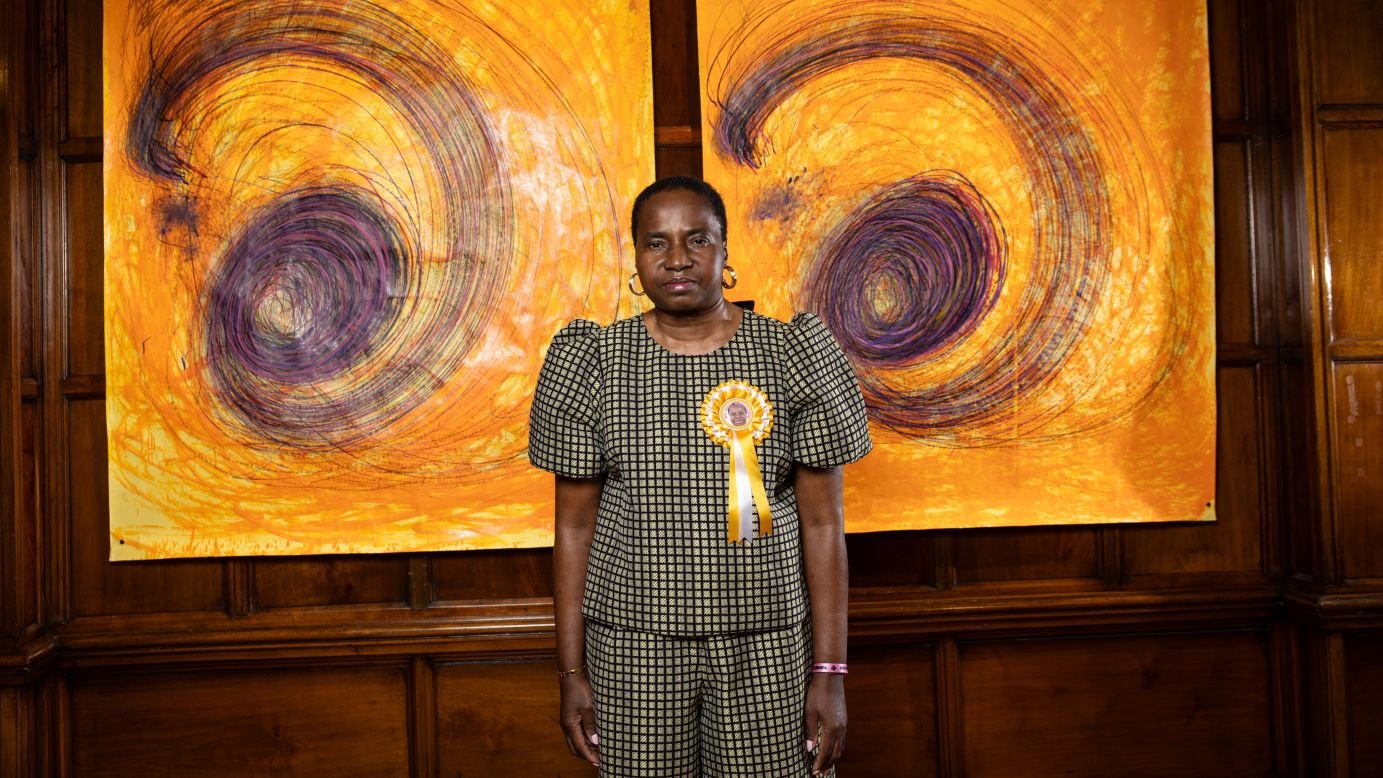
Nnena Kalu Makes History as First Artist With a Learning Disability to Win the Turner Prize
British-Nigerian artist Nnena Kalu has made history by winning the 2025 Turner Prize, becoming the first artist with a learning disability to receive one of Britain’s most prestigious visual arts awards since the prize was established in 1984.
Kalu, 59, who was born in Glasgow, was announced as the winner at a ceremony held at Bradford Grammar School on December 9, 2025, during Bradford’s year as the UK City of Culture. She receives the £25,000 prize, worth approximately $33,000.
The landmark victory represents a significant moment for disabled artists and for greater representation within the British contemporary art world.
Kalu is autistic and has limited verbal communication, but her artistic practice provides a powerful form of expression. Through colour, repetition, movement and rhythm, she creates striking works that communicate ideas and emotions without relying heavily on spoken language.
A Unique Artistic Language of Colour, Movement and Repetition
Kalu’s artistic practice spans large-scale drawings, sculpture and installation, with her work often characterised by vibrant colours, repetition and an intense sense of movement.
She is particularly recognised for two distinctive forms of work.
The first consists of vivid, swirling abstract drawings that appear to spiral and twist across the surface of the page. The repeated lines and energetic marks create a sense of motion, almost resembling vortices or rapidly moving currents.
Her second signature form is her hanging sculpture. These cocoon-like creations are made by repeatedly wrapping, winding and layering unconventional materials. Her materials have included masking tape, repurposed fabrics and shimmering strands recovered from VHS tapes.
The repetitive process is central to Kalu’s practice. Rather than simply being a technique, the act of wrapping and winding becomes part of the meaning and physical presence of the finished artwork.
Turner Prize Recognition
Kalu was recognised for two significant presentations of her work.
One was her contribution to Conversations at the Walker Art Gallery in Liverpool, an important group exhibition bringing together the work of 40 Black British female and nonbinary artists.
The second was Hanging Sculpture 1 to 10, a major installation presented among the concrete pillars of a disused power station as part of Manifesta 15 in Barcelona in 2024.
Her nomination placed her alongside three other highly regarded artists: Rene Matić, Mohammed Sami and Zadie Xa.
Mohammed Sami, whose autobiographical paintings were exhibited at Blenheim Palace, had been widely regarded as one of the favourites to win ahead of the ceremony. However, the jury ultimately selected Kalu, recognising the strength and significance of her artistic practice.
A Career Built Through ActionSpace
Kalu’s success is also closely connected to ActionSpace, the London-based nonprofit organisation that supports disabled artists.
She has worked at ActionSpace since 1999, developing her practice within a creative environment designed to support artists with learning disabilities.
The organisation played an important role in helping Kalu develop and sustain her artistic career, providing access to studio space, support and opportunities to exhibit her work.
Following the announcement, Charlotte Hollinshead of ActionSpace described the moment as historic, highlighting the significance of Kalu’s achievement for learning-disabled artists and the wider arts community.
The recognition is particularly important because disabled artists have historically faced barriers to visibility, funding and representation within major cultural institutions.
More Than a Disability Story
Kalu’s Turner Prize win has also prompted conversations about how the art world discusses artists with disabilities.
Curator and writer Lisa Slominski, who has written about Kalu’s practice, described the nomination as a watershed moment for learning-disabled artists appearing on the same international platforms as established contemporary artists.
At the same time, she has cautioned against viewing Kalu’s work exclusively through the lens of disability.
Her work can certainly be understood within the context of her experience as an autistic artist, but its artistic value extends beyond that identity. The colour, scale, repetition, physicality and rhythm of her work stand on their own as important elements of her creative practice.
Her Turner Prize victory therefore represents not only progress in disability representation but also recognition of the artistic strength of her work itself.
A Historic Moment for Representation
Founded in 1984 and named after the celebrated 19th-century British landscape painter J.M.W. Turner, the Turner Prize was originally established to promote young British artists.
Over the years, it has evolved into one of the most closely watched awards in contemporary British art and is now open to UK artists of any age.
Previous winners have included major names such as Damien Hirst, Grayson Perry, Anish Kapoor and Steve McQueen.
Kalu’s victory adds another important chapter to the prize’s history.
By becoming the first artist with a learning disability to win the award, she has helped challenge longstanding assumptions about who can participate in and achieve recognition within the contemporary art world.
Her achievement also sends a powerful message to emerging disabled artists: major artistic recognition can be possible, and their work deserves to be seen, discussed and taken seriously on the biggest stages.
Turner Prize Exhibition in Bradford
Visitors can also experience work from all four of the 2025 shortlisted artists.
An exhibition featuring the shortlisted artists is being presented at Cartwright Hall Art Gallery in Bradford, allowing audiences to explore the practices that competed for this year’s award.
The exhibition runs until February 22, 2026, giving visitors an opportunity to see Kalu’s work alongside that of Rene Matić, Mohammed Sami and Zadie Xa.
Nnena Kalu’s Turner Prize victory is ultimately about more than winning an individual award. It marks a significant step forward for representation in the British arts and highlights the importance of creating spaces where artists with learning disabilities can develop their work, reach wider audiences and receive recognition on equal terms.
For Kalu, decades of artistic practice, experimentation and dedication have culminated in one of the biggest honours in British contemporary art — and her historic win is likely to inspire a new generation of disabled artists to pursue their own creative voices.
Join Naija UK Connect
Stay updated with the latest UK visa sponsorship jobs, relocation opportunities, and career guides tailored for Nigerians through Naija UK Connect.
Join here: Naija UK Channel
Also, follow us on our social media channels for the latest updates and discussions:
Twitter: @NaijaUKConnect
Facebook: Naija UK Connect
Instagram: @naijaukconnect