
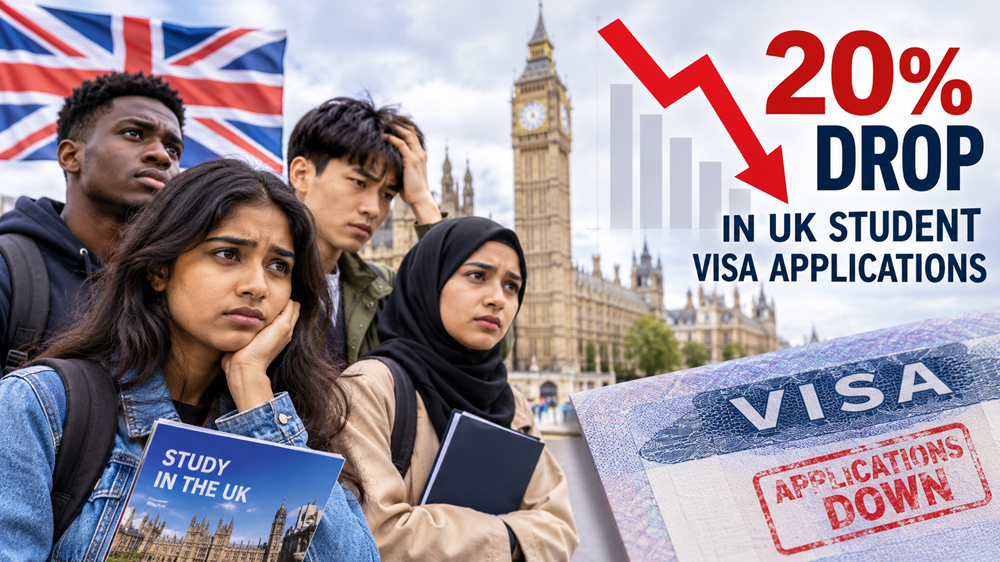
UK Student Visa Applications Fall by 20% in 2026 as Applications Drop by 84,100
By Naija UK Connect
November 15, 2026
The number of international students applying to study in the United Kingdom has fallen significantly, with new Home Office figures showing a 20% decline in student visa applications over the past year.
The latest figures highlight growing concerns about the UK’s attractiveness as a destination for international students, particularly amid tighter immigration rules, increased visa scrutiny, changes to post-study work opportunities and restrictions on bringing family members.
According to Home Office statistics published on 12 November 2026, the UK received 349,900 main applicant student visa applications in the year ending October 2026. This represents a decrease of 84,100 compared with the 434,000 applications recorded during the corresponding period in 2025.
The decline was particularly noticeable in October 2026, when the UK received approximately 5,800 main applicant student visa applications. This was 31% lower than the 8,400 applications recorded in October 2025 and 44% below the figure for October 2023.
For prospective international students, especially those from countries with historically high numbers of applicants to British universities, the figures point to an increasingly challenging immigration environment.
International Student Visa Applications Continue to Decline
The fall in applications has been particularly noticeable during the summer recruitment period, traditionally one of the busiest times for UK universities and educational institutions.
Between July and October 2026, the UK recorded 236,100 student visa applications. This was 16% lower than the 282,200 applications received during the same period in 2025.
Compared with the 323,100 applications recorded between July and October 2023, the latest figure represents a 27% decline.
October recorded the sharpest year-on-year reduction, suggesting that fewer prospective international students are progressing with plans to study in Britain.
Several factors may be contributing to this trend, including changes to immigration policy, rising education and living costs, concerns about visa refusals and uncertainty surrounding employment opportunities after graduation.
Growing Concerns for Students from Nigeria, Pakistan, India and Ghana
The decline in international student applications has raised particular concerns for countries that have traditionally supplied large numbers of students to UK universities.
These include Nigeria, Pakistan, India and Ghana, where prospective students and education agents have increasingly had to navigate additional immigration scrutiny and changing admission policies.
Another development attracting attention is the UK government’s visa brake, introduced in March 2026, affecting nationals of Afghanistan, Cameroon, Myanmar and Sudan.
Although the restrictions apply to specified nationalities, the wider policy changes have generated concerns among prospective students from other countries about whether additional immigration controls could be introduced in the future.
Universities are also facing greater pressure to maintain their student visa sponsorship compliance records.
Under the Basic Compliance Assessment requirements introduced in June 2026, educational institutions face the risk of losing their student sponsor licences if their visa refusal rates exceed the applicable threshold, including the 5% refusal-rate measure outlined in the policy.
Consequently, some institutions have reportedly restricted recruitment from certain countries to protect their sponsorship status.
The Financial Times has reported that at least 15 UK colleges have blocked recruitment from Pakistan, while at least nine have suspended recruitment from other countries considered higher risk.
These developments could reduce the number of available institutions for some international applicants and make securing admission more difficult.
Jonathan Hill, senior immigration manager at law firm Fragomen, reportedly identified restrictions on international recruitment as one of the factors contributing to the decline.
He also pointed to rising travel and living expenses, global economic uncertainty and changes to the UK’s Graduate Route as possible reasons behind the reduced demand.
Changes to UK Graduate Route Affect International Students
One of the UK’s biggest attractions for international students has traditionally been the opportunity to gain work experience after completing a university degree.
However, changes to the Graduate Route have created uncertainty for prospective students considering the UK.
In May 2025, the government announced plans to reduce the Graduate Route from two years to 18 months for eligible students graduating from January 2027.
The change has raised concerns among international applicants who consider post-study employment opportunities an important part of their decision to study abroad.
For many students, studying in the UK is not just about obtaining a degree. It is also an opportunity to gain professional experience, develop international careers and improve future employment prospects.
A shorter post-study work period could make the UK less attractive compared with other popular study destinations offering longer graduate employment opportunities.
However, there has been a potentially encouraging development.
Proposals announced in connection with the Autumn Budget could restore the two-year Graduate Route for eligible graduates from universities meeting proposed high-compliance standards and demonstrating strong labour market outcomes.
The proposal is intended to strengthen the UK’s international education sector and improve confidence among prospective overseas students.
However, the eligibility requirements and implementation arrangements have yet to be fully established. Students should therefore avoid making study or immigration decisions based on the proposed changes until official guidance is published.
Restrictions on Bringing Family Members to the UK
Another major factor affecting international students is the restriction on bringing dependants to the UK.
Home Office figures show that applications from student dependants fell by 32% to approximately 15,400 in the year ending October 2026.
This follows changes introduced in January 2024, which prevented most international students from bringing their spouses and children to the UK.
The main exceptions include eligible postgraduate research students and certain government-sponsored students.
According to the Home Office figures, dependant applications were 89% lower than in the year ending December 2023, before the restrictions were introduced.
For students hoping to relocate with their families, these rules have significantly changed the financial and practical considerations involved in studying in Britain.
Many prospective applicants must now decide whether to study in the UK alone or consider alternative destinations where family migration arrangements may be more flexible.
UK Universities Call for Changes to Restore International Student Confidence
The continued decline in student visa applications has raised concerns across the UK’s higher education sector.
International students contribute significantly to university finances, research activities, local economies and the wider education industry.
Although leading British universities continue to attract talented students from around the world, education sector representatives are concerned about the long-term impact of repeated immigration policy changes.
Zaid Kadhum, policy manager at the Russell Group, reportedly said the decline reflected the cumulative impact of government policy changes over several years rather than a sudden loss of international interest in British education.
He welcomed proposals to restore the two-year Graduate Route for graduates from qualifying universities, describing the development as a positive step.
However, he also urged the government to reconsider the proposed international student charge, warning that additional financial pressure could further undermine the UK’s position in the global education market.
Universities are therefore calling for a more predictable immigration framework that allows international students to make informed decisions about their education and future careers.
What the Decline Means for Nigerians and Other International Students
The 20% reduction in student visa applications does not mean that the UK has stopped accepting international students.
British universities continue to welcome applications from eligible students across the world, including Nigeria.
However, the latest figures highlight the importance of understanding current immigration requirements before committing to tuition fees, accommodation and other study-related expenses.
Prospective international students should pay particular attention to the following areas:
1. Check the university’s Student Sponsor Licence
Before accepting an admission offer, confirm that the institution holds a valid Student sponsor licence and is currently accepting applications from students in your country.
2. Understand the current visa requirements
Check the latest Home Office requirements covering financial evidence, English language proficiency, Confirmation of Acceptance for Studies (CAS) and supporting documentation.
3. Prepare carefully to avoid visa refusal
Ensure that all information supplied in your application is accurate, consistent and supported by the appropriate documents. Incomplete or misleading information could affect the outcome of your application.
4. Understand the dependant restrictions
If you intend to relocate with your spouse or children, establish whether your course qualifies under the current dependant rules before making financial commitments.
5. Check the latest Graduate Route rules
Do not assume that every international student will automatically qualify for two years of post-study work. Review the rules applicable to your course, graduation date and circumstances.
6. Calculate the full cost of studying in the UK
Consider tuition fees, accommodation, transportation, food, healthcare-related charges and other living expenses. The total cost of studying abroad can be significantly higher than the initial university fees suggest.
Is the UK Still a Good Destination for International Students?
Despite the decline in applications, the UK remains an important destination for international higher education.
Its universities continue to attract students seeking internationally recognised qualifications, research opportunities and access to global career networks.
However, immigration policy changes have made it increasingly important for prospective students to research their options carefully.
For Nigerian students and other international applicants, the key is to understand the rules currently in force, identify institutions that are actively recruiting international students and avoid relying on unconfirmed immigration policy proposals.
The coming months will be important in determining whether the government’s proposed changes to post-study work arrangements can restore confidence in the UK’s international education sector.
For now, the latest figures send a clear message: the UK remains open to eligible international students, but the process of studying and planning a future in Britain requires more careful preparation than ever.
Source: UK Home Office immigration statistics published on 12 November 2026, with additional policy and industry commentary referenced in the original report.
Naija UK Connect will continue to provide updates on UK student visas, immigration policy changes, university admissions and opportunities for Nigerians interested in studying in the United Kingdom.
Join Naija UK Connect
Stay updated with the latest UK visa sponsorship jobs, relocation opportunities, and career guides tailored for Nigerians through Naija UK Connect.
Join here: Naija UK Channel
Also, follow us on our social media channels for the latest updates and discussions:
Twitter: @NaijaUKConnect
Facebook: Naija UK Connect
Instagram: @naijaukconnect