
Understanding Cancer: How Normal Cells Become Cancer Cells and Spread
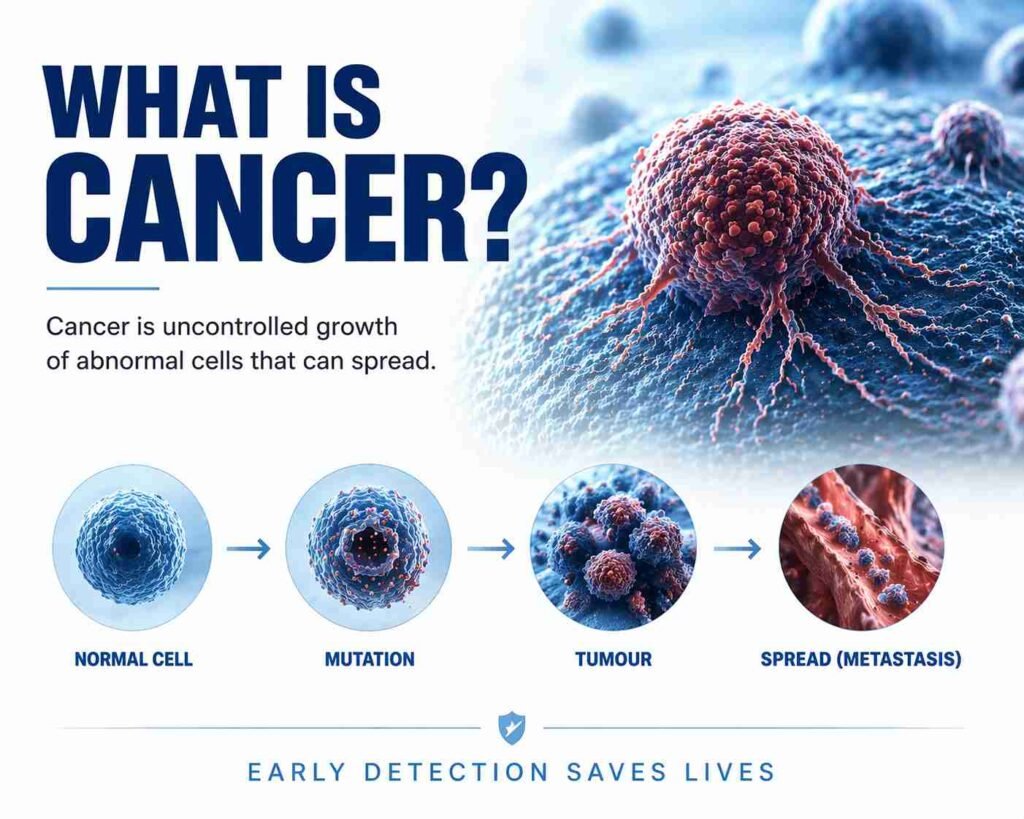
Cancer is a broad term used to describe a large group of diseases that develop when abnormal cells grow and divide without normal control. The human body contains trillions of cells that normally grow, divide, perform specialised functions and eventually die when they are no longer needed or become damaged.
Cancer develops when genetic and other cellular changes disrupt these normal processes. A cell may begin ignoring signals that tell it when to grow, when to stop dividing and when to undergo programmed cell death. Over time, these changes can allow abnormal cells to survive, multiply and form a tumour.
Cancer is not a single disease. There are many different types, and even cancers that develop in the same organ can have different genetic characteristics and behaviours. Some cancers grow relatively slowly, while others can develop and spread rapidly. These differences are important in determining how a cancer is detected and treated.
How Does a Normal Cell Become a Cancer Cell?
The transformation of a normal cell into a cancer cell usually involves multiple changes. A single abnormal cell may acquire characteristics that allow it to multiply beyond normal limits. Additional changes can then enable groups of cancer cells to form a tumour, obtain nutrients, invade nearby tissues and potentially spread to distant organs.
Researchers often describe several common characteristics, or hallmarks of cancer, that help explain how cancer cells behave differently from normal cells.
1. Growth Without Normal “Go” Signals
Normal cells generally require external signals before they begin dividing. These signals can come from growth factors, neighbouring cells and components of the tissue surrounding the cell.
Cancer cells can develop ways to grow without receiving the usual signals. For example, they may produce their own growth signals, alter growth-related receptors or influence nearby cells to provide signals that support continued growth.
As a result, cancer cells become less dependent on the normal mechanisms that regulate cell division.
2. Failure to Respond to “Stop” Signals
Normal cells receive signals that prevent them from continuing to divide when additional cells are not needed. One example is contact inhibition, in which cells respond to contact with neighbouring cells by slowing or stopping their growth.
Normal cells can also undergo differentiation, a process in which they develop specialised characteristics that allow them to perform particular functions.
Cancer cells can lose some of these normal controls. They may continue dividing despite signals that would normally tell healthy cells to stop.
3. Unlimited Cell Division
Most normal cells have limits on how many times they can divide. One factor involved in this limitation is the shortening of structures called telomeres, which protect the ends of chromosomes.
Many cancer cells overcome this limitation by activating mechanisms that maintain their telomeres. One important mechanism involves the enzyme telomerase.
By maintaining telomeres, cancer cells can continue dividing for much longer than most normal cells. This ability contributes to the continued growth of tumours.
4. Avoiding Programmed Cell Death
Healthy tissues maintain a balance between the production of new cells and the removal of damaged or unnecessary cells.
One important form of programmed cell death is called apoptosis. During apoptosis, a damaged or unnecessary cell is systematically dismantled and removed by the body.
Cells with severe abnormalities can normally be eliminated through these protective mechanisms. However, cancer cells can acquire changes that allow them to avoid or resist signals that would normally cause them to die.
When abnormal cells continue to divide while avoiding cell death, their numbers can increase and contribute to tumour formation.
Some cancer treatments work, in part, by triggering cell death in cancer cells.
5. Developing a Blood Supply
As a tumour grows, it may require additional oxygen and nutrients. To meet these demands, cancer cells and surrounding tissues can release signals that encourage the formation of new blood vessels.
This process is called angiogenesis.
New blood vessels can supply a growing tumour with oxygen and nutrients, supporting continued growth. Because angiogenesis can contribute to tumour development, it is also an important area of cancer research and treatment.
6. Invasion and Metastasis
One of the most significant characteristics of cancer is its ability, in some cases, to spread from its original location to other parts of the body.
The spread of cancer to a distant part of the body is called metastasis. A metastatic tumour is formed from cancer cells that originated elsewhere in the body.
The process involves several stages.
Leaving the Primary Tumour
Cancer cells normally remain connected to neighbouring cells and the surrounding tissue through structures called adhesion molecules.
Some cancer cells undergo changes that reduce these connections. This can make it easier for them to move away from the original tumour.
Entering the Blood or Lymphatic System
The process by which cancer cells enter a blood vessel is called intravasation.
After entering the circulation, cancer cells face significant challenges. They must survive physical forces within the bloodstream and avoid destruction by the body’s immune system.
Cancer cells can interact with platelets, which may help protect them during their journey through the circulation.
Travelling Through the Circulation
Once cancer cells enter the bloodstream or lymphatic system, they may travel to other parts of the body.
Most circulating cancer cells do not successfully establish new tumours. Cells that survive the journey must still leave the circulation and adapt to a new environment.
Leaving the Bloodstream
The process through which cancer cells leave a blood vessel is called extravasation.
Cancer cells may become trapped in small blood vessels or interact with molecules in particular tissues that help them attach to and enter surrounding tissue.
Establishing a New Tumour
After reaching another organ, a cancer cell must survive and adapt to its new environment. If it successfully grows and multiplies, it can eventually form a secondary tumour.
This complex process explains why metastasis is challenging to treat and why cancer research continues to focus heavily on understanding how cancer cells spread.
Physical Changes in Cancer Cells
Cancer cells can develop physical and structural characteristics that distinguish them from normal cells.
These changes may help cancer cells grow, move through tissues and invade surrounding areas.
Changes in the Cytoskeleton
The cytoskeleton is the internal framework that helps maintain a cell’s shape and supports movement and interactions with other cells.
Cancer can alter the organisation and activity of cytoskeletal components such as microfilaments and microtubules. These changes can affect the appearance, movement and interactions of cancer cells.
Changes in Cell Adhesion and Movement
Normal cells are generally connected to neighbouring cells and the surrounding tissue. Cancer cells may lose or alter some of these connections.
Reduced adhesion can make it easier for cancer cells to move through surrounding tissues and, in some cases, spread to distant parts of the body.
Changes in the Nucleus
The nucleus contains much of a cell’s genetic material. Cancer cells may have nuclei that differ noticeably in size, shape and organisation from those of normal cells.
These microscopic changes can provide useful information when doctors examine tissue samples to help diagnose and classify tumours.
Production of Enzymes
Some cancer cells produce enzymes that can break down components of the surrounding tissue.
By weakening these physical barriers, cancer cells may be able to invade nearby tissues and facilitate their movement.
Why Cancer Is Difficult to Treat
Cancer treatment can be challenging because cancer is not one uniform disease. Different cancers can contain different genetic changes and can behave differently.
Even two patients with the same general type of cancer may have tumours with different biological characteristics.
Cancer cells can also change over time. As cells divide, additional genetic changes may develop, creating groups of cells with different characteristics within the same tumour.
These differences can influence how a cancer responds to treatment and are an important reason why doctors use different approaches depending on the type and characteristics of the cancer.
Summary: The Major Hallmarks of Cancer
Cancer cells can acquire a combination of abilities that allow them to survive and multiply beyond normal controls. Key characteristics include:
- Growing without normal external growth signals
- Ignoring signals that normally stop cell division
- Continuing to divide for an extended or effectively unlimited period
- Avoiding programmed cell death
- Promoting the formation of new blood vessels
- Invading surrounding tissues
- Spreading to distant organs through metastasis
Cancer cells can also undergo physical changes involving their cytoskeleton, adhesion mechanisms, nuclei and enzyme production.
Understanding the Bigger Picture
Cancer develops through a complex series of biological changes rather than a single event. A normal cell may gradually acquire abnormalities that allow it to grow independently of normal controls, survive when it should die, obtain resources from its environment and invade surrounding tissues.
Further changes may enable some cancer cells to enter the circulation, travel to distant organs and establish new tumours.
Understanding these processes is essential to cancer research because each stage provides opportunities for scientists and doctors to develop better methods of prevention, detection, diagnosis and treatment.
Important: Cancer is a complex group of diseases, and information about cancer biology does not replace professional medical advice. Anyone concerned about symptoms, screening, diagnosis or treatment should speak with a qualified healthcare professional.
Join Naija UK Connect
Stay updated with the latest UK visa sponsorship jobs, relocation opportunities, and career guides tailored for Nigerians through Naija UK Connect.
Join here: Naija UK Channel
Also, follow us on our social media channels for the latest updates and discussions:
Twitter: @NaijaUKConnect
Facebook: Naija UK Connect
Instagram: @naijaukconnect