
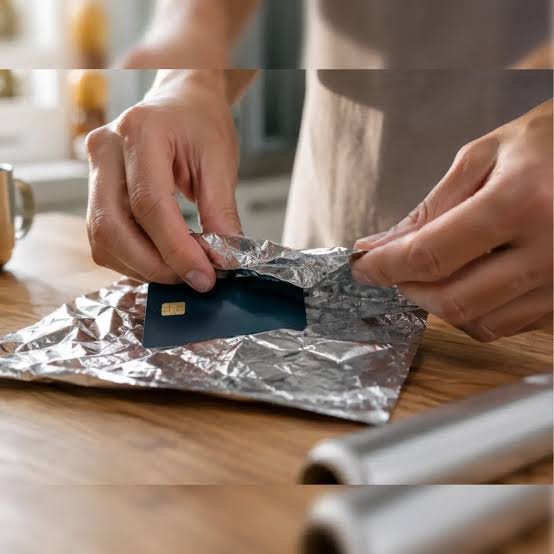
Why Some People Wrap Their Wallets in Aluminium Foil to Prevent Wireless Theft
By ldadmin | July 20, 2026
Summary
Many modern wallets contain cards with RFID (Radio Frequency Identification) or NFC (Near Field Communication) chips that can be read wirelessly. These include Enhanced Driver’s Licenses, passport cards, transport passes, workplace access badges, and contactless payment cards. Wrapping a wallet in aluminium foil can help block radio signals, reducing the risk of unauthorised scanning. While this is an inexpensive solution, experts say purpose-built RFID-blocking wallets or sleeves offer better long-term protection.
Scroll through TikTok or other social media platforms, and you may come across videos of people wrapping their wallets in aluminium foil. At first glance, it might seem like an odd internet trend, but there’s a practical reason behind it.
Today’s wallets often carry more than cash and bank cards. Many now contain government-issued IDs, passport cards, transit passes, employee badges, and contactless payment cards equipped with RFID or NFC technology. These wireless chips are designed for convenience, allowing quick access at border crossings, transport stations, offices, and payment terminals. However, that same convenience has raised privacy and security concerns.
Why Wireless Theft Is a Concern
RFID technology allows compatible readers to detect certain cards without physical contact. Privacy advocates have long warned that some RFID-enabled documents can be read from surprisingly long distances.
According to the American Civil Liberties Union (ACLU), the unique identification number stored on Enhanced Driver’s Licenses (EDLs) can be detected by commercial RFID readers from significant distances under certain conditions. The organisation has argued that this creates opportunities for unauthorised tracking or data collection, even though the chip itself does not store personal information.
The concern isn’t that criminals can instantly empty your bank account from across the street. Instead, the greater risk involves unauthorised scanning of unique identification numbers that could potentially be used for tracking or profiling without your knowledge.
How Aluminium Foil Helps
Aluminium is an excellent electrical conductor. Conductive materials interfere with radio waves, making it difficult for RFID signals to pass through. This is the same principle behind a Faraday cage—a metal enclosure that blocks electromagnetic signals.
When a wallet is completely wrapped in aluminium foil, the foil acts as a barrier that significantly reduces the ability of RFID readers to communicate with the cards inside.
Cybersecurity experts note that aluminium foil does not damage RFID cards or chips. Instead, it simply prevents wireless signals from reaching them.
Does It Actually Work?
Yes—but only to a point.
Aluminium foil can effectively block RFID signals if it completely surrounds the wallet with no gaps or tears. However, kitchen foil is fragile and can easily rip, reducing its effectiveness over time.
Several tightly wrapped layers generally provide better protection than a single loose layer.
Even so, experts caution that aluminium foil should be viewed as a temporary or emergency solution rather than a permanent one. Factors such as the RFID frequency, chip design, and the quality of the foil wrapping all influence how well it performs.
For everyday use, RFID-blocking wallets and protective sleeves are considered more reliable because they are specifically engineered with durable conductive materials designed to shield wireless signals.
Which Cards Are Most Vulnerable?
Not every contactless card presents the same level of risk, but several commonly carried items use RFID technology, including:
- Enhanced Driver’s Licenses (available in Washington, Michigan, Minnesota, New York, and Vermont)
- U.S. Passport Cards
- Workplace access badges
- University ID cards
- Public transport passes
- Some contactless payment cards
Enhanced Driver’s Licenses allow eligible travellers to cross land and sea borders with Canada, Mexico, Bermuda, and parts of the Caribbean without carrying a passport book. Instead of storing personal data, the RFID chip contains a unique identification number linked to a secure government database.
Similarly, U.S. passport cards use long-range RFID technology for faster border processing. For this reason, the U.S. State Department supplies passport cards with protective RFID sleeves to minimise unauthorised scanning.
More Than Just Credit Cards
Many people assume RFID security is only about protecting payment cards. In reality, the average wallet may contain several wirelessly readable items.
A typical wallet today might hold:
- A driver’s licence
- A passport card
- Contactless debit or credit cards
- A work ID badge
- A public transport card
Rather than focusing on protecting a single card, security experts recommend viewing the entire wallet as something worth shielding.
The Better Alternative
While wrapping your wallet in aluminium foil is an inexpensive way to reduce wireless scanning, it isn’t the most practical solution for everyday use.
RFID-blocking wallets and protective sleeves are designed specifically for this purpose. They provide stronger, longer-lasting protection without the inconvenience of repeatedly wrapping and replacing foil.
Final Thoughts
The aluminium foil trend isn’t simply another social media gimmick. It reflects growing awareness that many everyday cards communicate wirelessly and could, under certain circumstances, be scanned without the owner’s knowledge.
Although the overall risk of financial theft through RFID skimming remains relatively low, protecting sensitive identification documents from unauthorized scanning is a sensible precaution. Whether you choose aluminium foil as a temporary fix or invest in an RFID-blocking wallet, taking steps to protect your personal information is becoming increasingly worthwhile in today’s contactless world.
Join Naija UK Connect
Stay updated with the latest UK visa sponsorship jobs, relocation opportunities, and career guides tailored for Nigerians through Naija UK Connect.
Join here: Naija UK Channel
Also, follow us on our social media channels for the latest updates and discussions:
Twitter: @NaijaUKConnect
Facebook: Naija UK Connect
Instagram: @naijaukconnect