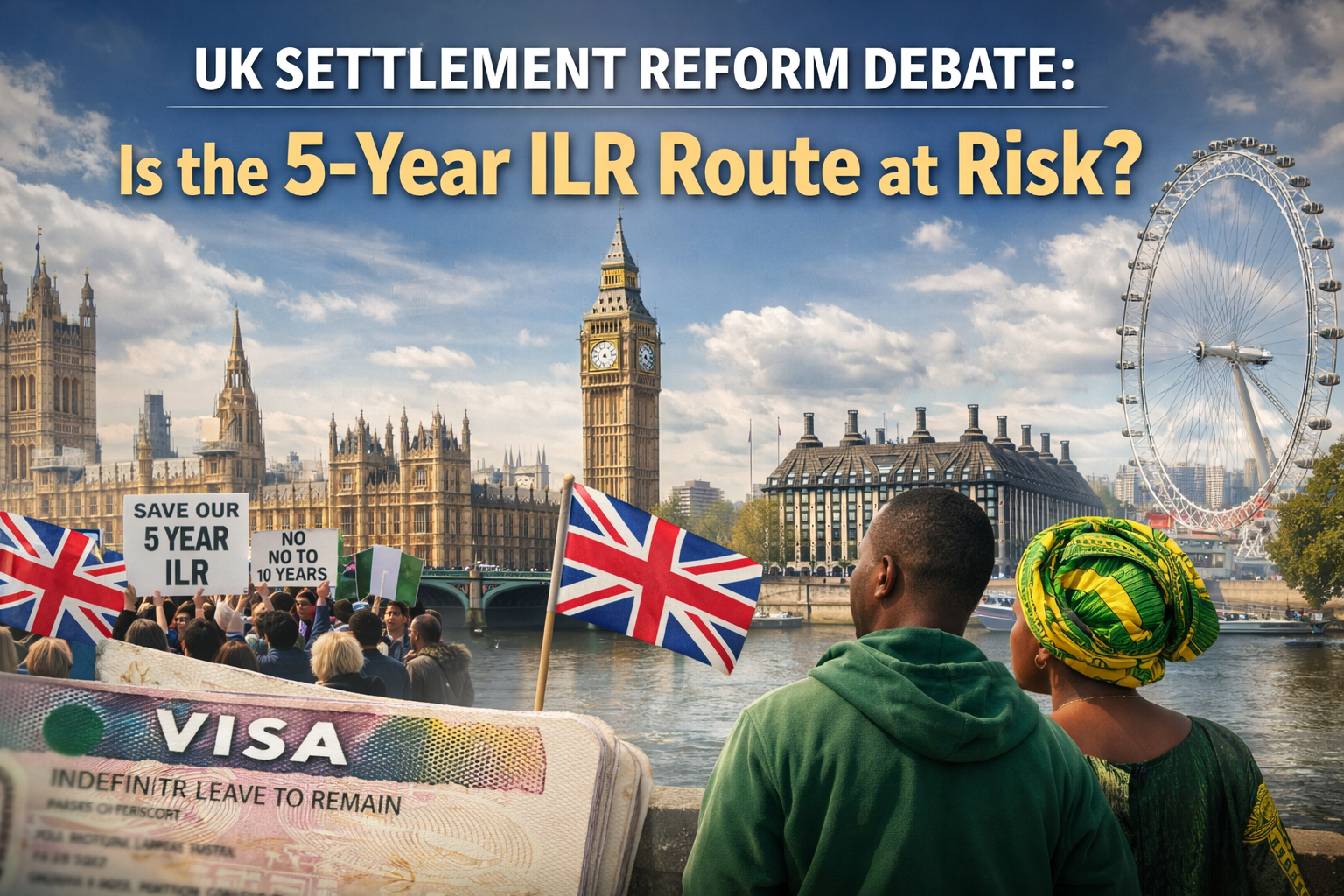
The future of the UK’s five-year Indefinite Leave to Remain (ILR) route is under serious debate, and this could directly affect thousands of Nigerians living and working in the UK.
UK MPs are currently considering proposals that could extend settlement timelines, restrict benefit access, and fundamentally change how migrants qualify for permanent residence. For many Nigerians who planned their lives around the current five-year ILR route, this has raised major concerns.
What Is Happening?
Under the current system, most work-based migrants — including Skilled Workers, Health and Care Workers, and family visa holders — can apply for ILR after five years of continuous lawful residence.
Once ILR is granted, migrants gain:
- Freedom to work without sponsorship
- Long-term stability for families
- Access to public funds (in most cases)
However, new proposals outlined in the UK Government’s 2025 Immigration White Paper suggest this could change.
What Changes Are Being Proposed?
The government is considering a shift away from the predictable five-year route to a longer and more conditional settlement system, including:
- Extending ILR eligibility from 5 years to 10 years for many migrants
- Even 15-year routes for lower-paid or “non-priority” roles
- Different settlement timelines based on salary, skill level, and occupation
- Continuing “No Recourse to Public Funds” (NRPF) even after ILR, until citizenship
- Possible retrospective application, affecting migrants already in the UK
If approved, these changes could start from April 2026, with no confirmed protection for people already close to ILR.
Why Is the Government Pushing This?
According to ministers, the reforms are driven by:
- Rising net migration figures
- Political pressure to appear “tough” on immigration
- Concerns about long-term public spending
- An argument that settlement should be “earned” through economic contribution
Critics argue that migrants already contribute through taxes, essential work, skills shortages, and strict visa compliance, especially in sectors like healthcare and social care where Nigerians are heavily represented.
Why Nigerians in the UK Should Pay Attention
Many Nigerians in the UK work in:
- Health and social care
- Education
- Tech and engineering
- Financial services
These sectors rely heavily on migrant workers. Extending settlement timelines could lead to:
- Long-term visa insecurity (constant renewals for 10+ years)
- Family stress, especially around housing and children’s education
- Mental health strain due to uncertainty
- Workers leaving the UK for countries with clearer permanent residence routes
Importantly, many Nigerians moved to the UK based on the clear promise of a five-year ILR pathway. Changing the rules mid-journey raises serious questions about fairness and trust.
Public Reaction: Petitions and Protests
Public opposition to the proposals has grown rapidly. Two major petitions have gained strong support:
- Protect the 5-Year ILR Route for Lawful Migrants
- Over 107,000 signatures
- Demands protection for migrants already in the UK
- Do Not Extend ILR to 10 Years
- Over 232,000 signatures
- Argues benefits access can be restricted without changing settlement timelines
Both petitions are scheduled for Parliamentary debate on 2 February 2026, showing how serious the issue has become.
How Does the UK Compare Globally?
Compared to other major migration destinations:
- Canada: Permanent residency in 3–5 years
- Australia: Clear PR pathways linked to skills and jobs
- EU countries: Stronger protections once residency is established
If the UK moves to 10–15 year settlement routes, it risks becoming one of the least attractive destinations for skilled migrants, including Nigerians.
Will These Changes Actually Work?
Experts warn the reforms may not achieve their goals:
- Settlement timing doesn’t significantly reduce migration numbers
- Skilled workers may choose other countries
- Longer uncertainty can harm integration and productivity
- More visa renewals increase Home Office workload and costs
Many migrants have said they would rather delay benefits than lose a clear and predictable settlement pathway.
What Happens Next?
Parliament’s upcoming debate could influence whether:
- The five-year ILR route is protected
- Transitional arrangements are introduced
- Or the reforms move forward as proposed
Previous cases — like protections granted to Hong Kong BNO visa holders — show that public pressure can make a difference.
Final Thoughts
This debate is no longer just about immigration control — it’s about trust, fairness, and the UK’s global reputation.
For Nigerians in the UK, the outcome could shape:
- Career decisions
- Family stability
- Long-term settlement plans
Naija UK Connect will continue to monitor developments closely and provide updates that matter to our community.
👉🏽 If you’re on a Skilled Worker, Health & Care, or family route, now is the time to stay informed and prepared.
Join Our WhatsApp Channel
Stay updated on the latest UK news, including education, health, job openings, and more for those living in the UK!
Join here: Naija UK Channel
Also, follow us on our social media channels for the latest updates and discussions:
- Twitter: @NaijaUKConnect
- Facebook: Naija UK Connect
- Instagram: @naijaukconnect