UK Skilled Worker Visa 2026: Major Modern Slavery Rule Change Gives Eligible Workers More Freedom
Published: 14 October 2026
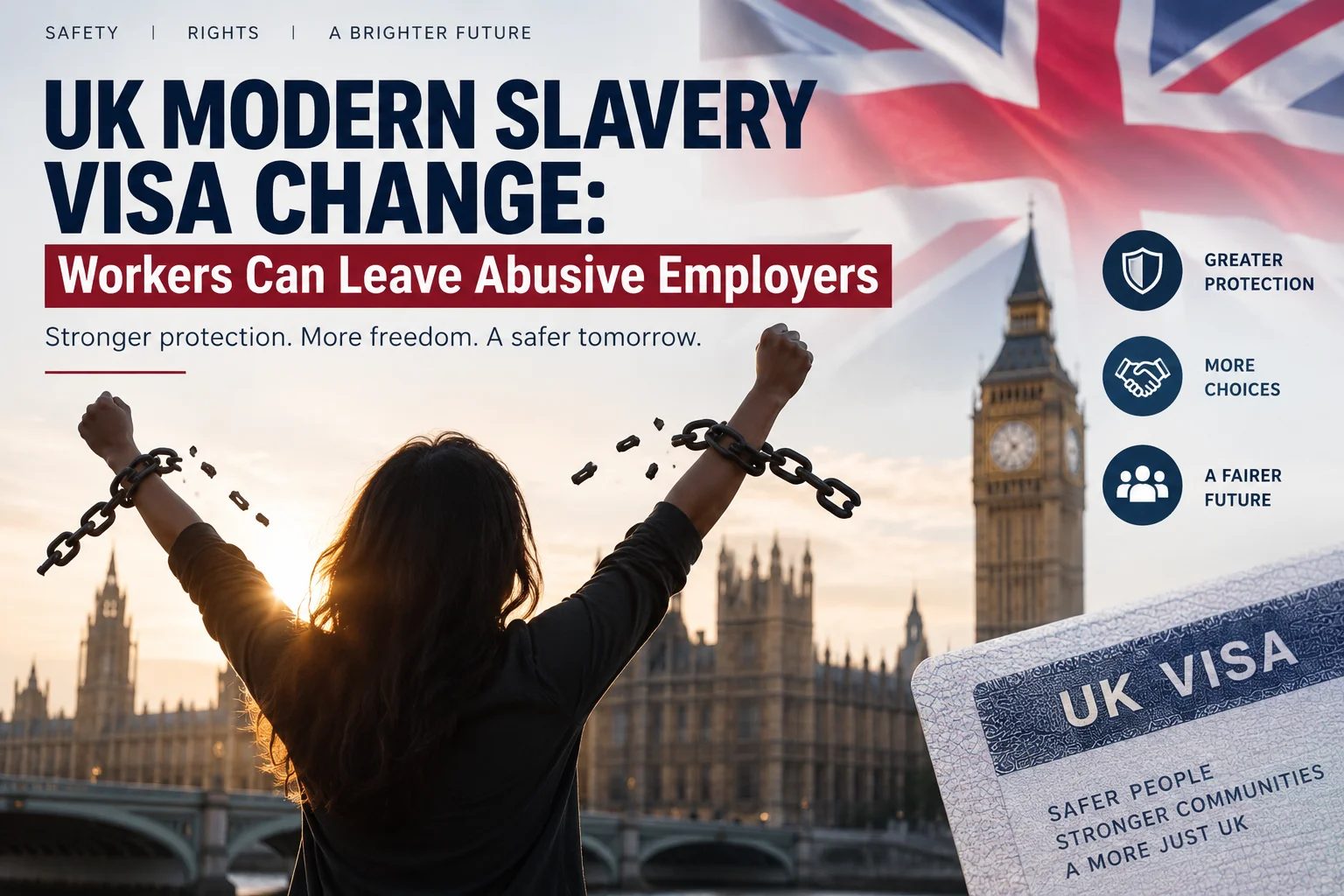
The UK government has introduced an important change to the Skilled Worker visa rules designed to help protect eligible migrants who have experienced modern slavery or exploitation.
Under changes introduced through Statement of Changes HC 584, certain Skilled Workers who receive a positive conclusive-grounds decision through the UK’s National Referral Mechanism (NRM) may be permitted to work for other employers for the remainder of their existing visa permission.
The change could help eligible workers move away from exploitative employment arrangements without automatically having to secure a new Certificate of Sponsorship (CoS) to change employers.
The development comes as the Home Office reports a substantial reduction in the number of modern slavery cases awaiting a conclusive-grounds decision. As of 30 September 2026, 6,277 cases were awaiting a decision, compared with a peak of 31,101 in January 2023. The latest figure represents an 80% reduction, although cases remain outstanding.
What Has Changed for Skilled Worker Visa Holders?
Previously, many Skilled Workers faced significant difficulties when trying to leave an employer who was exploiting them. Because their immigration permission was tied to sponsored employment, changing jobs could involve additional immigration requirements and uncertainty about their right to remain and work in the UK.
The revised rules introduce a specific provision for qualifying workers who have been referred to the NRM and have received a positive conclusive-grounds decision during their most recent period of immigration permission.
Under the amendment to paragraph SW 18.3, the conditions attached to their permission may be changed to allow them to undertake work for any employer, including self-employment and voluntary work, except work as a professional sportsperson or sports coach.
This is an important distinction: the change does not automatically apply to every Skilled Worker who reports exploitation or enters the NRM. The relevant decision and immigration conditions must meet the requirements set out in the updated rules.
What Is the National Referral Mechanism?
The National Referral Mechanism is the UK’s framework for identifying and supporting potential victims of modern slavery and human trafficking.
The process involves two main decisions:
- Reasonable-grounds decision: An initial assessment of whether there are reasonable grounds to believe that a person may be a victim of modern slavery.
- Conclusive-grounds decision: A later decision assessing whether the available evidence establishes that the person is a victim of modern slavery on the balance of probabilities.
A positive conclusive-grounds decision is particularly relevant to the new Skilled Worker provision.
For eligible workers, receiving this decision during their most recent period of permission may enable the Home Office to amend their work conditions under the revised rules.
Home Office Reports an 80% Reduction in Outstanding Cases
The Home Office published updated NRM statistics on 8 October 2026, reporting the number of cases awaiting conclusive-grounds decisions as of 30 September 2026.
The figures show a substantial reduction from the peak recorded in early 2023.
<box border radius=”lg” padding={4} gap={3}> <text color=”secondary” size=”sm”>Cases awaiting a conclusive-grounds decision</text> <grid columns={2} gap={3}> <grid-item> <title size=”xl” color=”default”>31,101</title> <text color=”secondary” size=”sm”>Peak, January 2023</text> </grid-item> <grid-item> <title size=”xl” color=”success”>6,277</title> <text color=”secondary” size=”sm”>As of 30 September 2026</text> </grid-item> </grid> <divider color=”subtle” /> <text>**80% reduction** from the recorded peak.</text> </box>
The Home Office says reducing delays should help potential victims receive decisions sooner, allowing those recognised as victims to access relevant protections more quickly. The government has also linked faster decision-making to its wider efforts to prevent the immigration system from being misused to delay the removal of people who have no right to remain in the UK.
The statistics are provisional and reflect the number of cases awaiting decisions at a particular point in time. They do not mean that all modern slavery cases have been completed or that no applicants are still waiting. <Cite refs={[“turn685914search1″,”turn685914search2”]} />
Can Recognised Victims Change Employers Without a New Certificate of Sponsorship?
For workers who meet the conditions of the new provision, the answer may be yes.
The updated rule allows the relevant work conditions to be amended so that eligible individuals can work for other employers for the remainder of their existing permission. This is intended to reduce the immigration barriers that could otherwise make it harder for victims to leave exploitative employment.
However, workers should not assume that a referral to the NRM, a pending decision or an initial positive reasonable-grounds decision automatically grants unrestricted work permission.
Before starting a new job, workers should confirm that the Home Office has amended their conditions and that their digital immigration status reflects their current right to work.
The permission is limited to the remaining validity of their existing immigration permission. It does not automatically extend their visa or grant settlement in the UK.
What Employers Need to Know
The change is relevant to employers recruiting migrant workers, particularly businesses that rely on sponsored labour.
Employers should continue to conduct the appropriate right-to-work checks before employment begins. Where a prospective employee says their immigration conditions have changed following a positive NRM decision, the employer should verify their current status and the work they are permitted to undertake.
Businesses should also ensure that recruitment practices, staff reporting procedures and safeguarding policies are designed to identify and respond appropriately to possible exploitation.
Organisations that use labour providers or subcontractors should consider whether their existing procedures adequately address the risk of modern slavery within their supply chains.
The rule change does not remove employers’ legal obligations concerning right-to-work checks, workplace safety or compliance with applicable employment and immigration law.
What Does This Mean for Sponsored Workers in Care, Hospitality and Construction?
Workers in sectors such as care, hospitality and construction may be concerned about exploitation, particularly where their employment and immigration status are closely connected.
The updated provision may offer an important safeguard to Skilled Workers who meet its requirements. It can help qualifying individuals move away from an exploitative employer without automatically being restricted to that employer for the remainder of their permission.
However, not every workplace dispute, unfair dismissal or disagreement over pay amounts to modern slavery. Each case must be assessed on its own circumstances, and the new immigration provision has specific eligibility conditions.
Workers who believe they are being exploited should consider seeking help from an appropriate support organisation, qualified immigration adviser or legal professional.
What Happens Next?
The government has presented the rule change as part of its wider response to modern slavery and delays in the NRM decision-making process.
Further developments may follow as the government continues its work on modern slavery protections, sponsor compliance and the proposed Immigration and Asylum Bill.
Employers and sponsored workers should monitor official Home Office announcements for any further changes to reporting requirements, sponsorship procedures or the way updated immigration conditions are recorded.
Frequently Asked Questions
1. Can a Skilled Worker who is a victim of modern slavery work for any employer?
Certain Skilled Workers may qualify if they have been referred to the NRM and received a positive conclusive-grounds decision during their most recent permission. The Home Office must amend the relevant work conditions, and the permission remains subject to the applicable rules.
2. Is a new Certificate of Sponsorship required?
Where the updated conditions permit work for any employer, the worker may not need a new CoS simply to change employers during the remaining period of that permission. The individual should verify their amended conditions before beginning work.
3. Does the new rule automatically extend a Skilled Worker visa?
No. The provision concerns permitted work during the remaining validity of existing immigration permission. It does not automatically extend the visa or grant indefinite leave to remain.
4. Is a positive reasonable-grounds decision enough?
Do not assume so. The specific provision refers to a positive conclusive-grounds decision made during the worker’s most recent permission. Applicants should check the detailed rule and their individual circumstances.
5. What should an eligible worker do before changing jobs?
The worker should confirm that the Home Office has amended their work conditions and check their current digital immigration status. They should also ensure that the proposed employment is permitted under those conditions.
Final Thoughts
The October 2026 Skilled Worker rule change represents an important development for eligible migrants recognised as victims of modern slavery. By allowing qualifying workers to undertake work for other employers for the remainder of their existing permission, the government aims to reduce the immigration barriers that can make leaving exploitative employment difficult.
The reduction in outstanding NRM cases is also significant, although thousands of cases were still awaiting conclusive-grounds decisions at the end of September 2026.
For workers, the priority is to understand whether the new provision applies to their circumstances and to confirm their actual work permission before changing jobs. Employers should continue to carry out the appropriate checks and take concerns about exploitation seriously.
Official sources:
- Statement of Changes to the Immigration Rules: HC 584 – GOV.UK
- Modern slavery: NRM cases awaiting a conclusive-grounds decision, September 2026 – GOV.UK
- Modern slavery decision backlog cleared – GOV.UK
Disclaimer: This article is for general information only and does not constitute legal advice. Immigration rules and individual work conditions can differ, so check the current Home Office guidance or consult a qualified UK immigration adviser before making decisions.
Join Naija UK Connect
Stay updated with the latest UK visa sponsorship jobs, relocation opportunities, and career guides tailored for Nigerians through Naija UK Connect.
Join here: Naija UK Channel
Also, follow us on our social media channels for the latest updates and discussions:
Twitter: @NaijaUKConnect
Facebook: Naija UK Connect
Instagram: @naijaukconnect